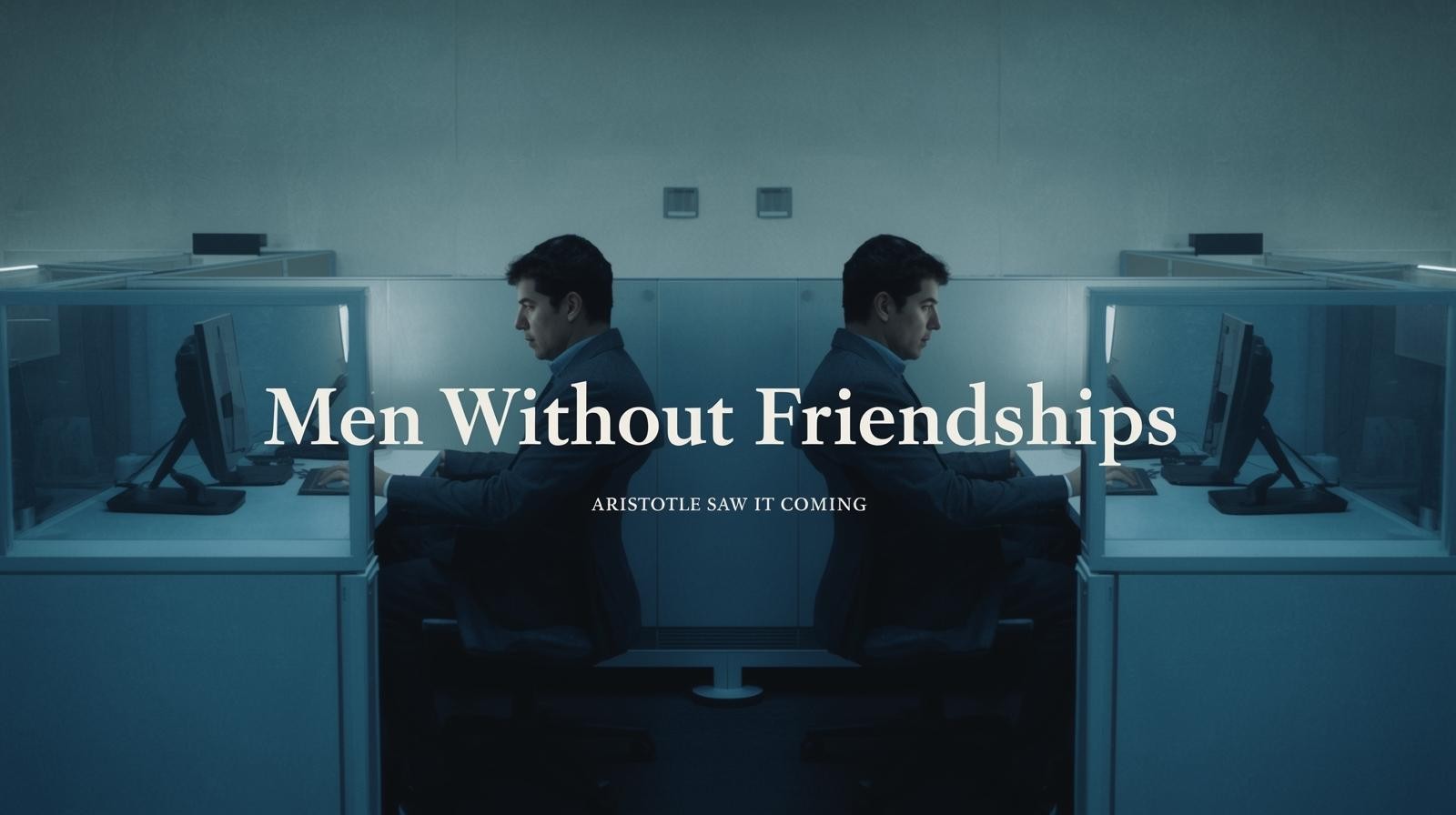
MEN WITHOUT FRIENDSHIPS — Part 2 of 3
We like to believe loneliness is an accident, a by-product of progress, a small price for the comfort and convenience of modern life. But it is not an accident; it is the architecture of our age. The machines that promised connection have built invisible walls around us. The neighborhoods that once echoed with laughter now pulse with the soft blue light of screens behind closed blinds. The rituals that once required us to show up; church, sport, guild, lodge have been replaced by subscriptions and streams. We have been taught to worship private life and to distrust the communal one, to see every group as a threat to freedom rather than the soil from which freedom grows.
Robert Putnam saw this decades ago when he wrote Bowling Alone. He tracked the collapse of the very places where virtue friendships once took root: the bowling leagues, the PTA, the choir, the VFW hall, the neighborhood barbecue. Americans, he found, still joined things, but they joined alone. They sent money instead of showing up. They watched instead of participating. Between 1973 and 1993, civic participation fell by half. Trust in neighbors dropped. The average American reported having three close friends in 1985; by 2004, the number had fallen to two. By 2020, many men quietly confessed to having none.
We tell ourselves this is harmless, that technology compensates. But a friendship mediated by algorithms is not the same as the friendship formed in sweat, service, or shared struggle. The glow of a screen cannot replace the weight of a hand on your shoulder. Social media offers us the appearance of belonging without the demands of it. It allows us to curate affection while avoiding the friction that breeds growth. We are learning to be seen without being known, and to speak without truly saying anything.
The Harvard Study of Adult Development shows what this costs us. The data are merciless: men with strong relationships in midlife were the healthiest in old age. Those without no matter their wealth, education, or genetics were more likely to die early, to suffer depression, to see their minds decay. “Loneliness kills,” the study concluded, “it’s as powerful as smoking or alcoholism.” Our hearts, quite literally, grow weaker when they beat alone. The body interprets isolation as danger. Cortisol rises. Sleep falters. Inflammation blooms. The immune system panics. The organism that once thrived in tribes now decays in apartments.
But the damage is not merely biological. It is existential. A man without close friends begins to lose his reflection. No one calls him to account. No one bears witness to his small victories. The world becomes flat, silent, and indifferent. Without that mirror, he can drift into caricature, either the self-absorbed performer or the silent ghost. Without friends of virtue, revolt curdles into resentment, lucidity collapses into cynicism, and passion fades into apathy. He may still go through the motions; work, gym, bills; but the inner dialogue becomes a monologue. He becomes his own echo chamber.
The tragedy is that most men sense this void but cannot name it. They feel the dull ache after gatherings where no one spoke truth. They feel it when they scroll through photos of weddings, births, adventures, always as spectators. They feel it in the sterile camaraderie of the workplace, where loyalty lasts only until the next restructuring. They feel it in the long evenings where they drink not to celebrate, but to simulate connection. Yet when asked, they say they are fine. They have contacts, colleagues, “the guys.” But beneath that inventory lies an ancient hunger: to be seen by another man who wants nothing from you except your good.
The pandemic years made this hunger impossible to ignore. When isolation became policy, we discovered how fragile our social scaffolding really was. Men who already lived half-alone suddenly found themselves fully so. Some retreated into the digital world and never returned. Others began to realize that without touch, ritual, or shared struggle, life became unbearable. It was a collective experiment in loneliness and the results were devastating. Rates of depression, substance abuse, and suicide spiked. It was as if the soul itself had been deprived of oxygen.
Camus understood this long before the data. In The Plague, he describes the citizens of Oran cut off from one another by quarantine. “They thought they were free,” he wrote, “and no one will ever be free so long as there are pestilences.” His plague was both literal and symbolic: the human condition itself, the absurd separation between our yearning for meaning and a world that offers none. Yet amid the suffering, something extraordinary happens. The characters: Dr. Rieux, Tarrou, Rambert choose to fight the plague together, not because they believe they can win, but because solidarity itself becomes their revolt. “What’s true of all the evils in the world is true of plague as well. It helps men to rise above themselves.”
That is the lesson modern men have forgotten. In the face of absurdity, the answer is not withdrawal, but fellowship. Virtue-friendship is not sentimental; it is resistance. It is the deliberate act of saying, “You matter to me,” in a universe that says nothing matters. It is choosing to link arms against the void. The absurd hero does not need friendship to survive; he chooses it to live a better life. He knows that meaning is not found but forged, and that the forge requires heat, pressure, and other souls.
Consider Sisyphus again. Alone on his mountain, condemned to push the stone forever, Camus imagines him happy. Why? Because he accepts the absurd. He owns his struggle. Yet even Camus hints that joy arises from consciousness, and consciousness deepens through recognition. Imagine, then, that Sisyphus is not alone, that another figure stands beside him, pushing his own boulder, laughing at the futility, shouting encouragement. Suddenly the punishment becomes a communion. The absurdity remains, but the loneliness dissolves. The mountain echoes with laughter. That is the image of virtue-friendship in an absurd world: not rescue, but recognition.
When nobody really sees you, your soul begins to erode. Without a mirror for growth, there is no accountability, without accountability, no transformation. To live without friends of virtue is to live without witnesses, and a life without witnesses slowly forgets itself. Aristotle would say we cannot even practice virtue properly without friends, because friendship is where virtue takes shape. Courage means nothing if no one depends on you. Honesty means nothing if no one can trust you. Generosity means nothing if there is no one to receive it. We become ethical solipsists, morally awake but relationally dead.
Some men try to replace friendship with romantic love, expecting a partner to fill every role. But that is too much weight for one bond to bear. Love and friendship are cousins, not twins. Friendship allows a man to wrestle with his own nature in a way romance cannot. In friendship, we sharpen each other; in isolation, we dull. “Friendship is essentially a partnership,” Aristotle wrote, “and partnerships are for mutual good.” Without that partnership, we lose the apprenticeship of the soul.
Look around and you can see the symptoms everywhere. Online discourse dominated by outrage because men have no friends to test their ideas before broadcasting them. Workplaces rife with silent competition because men have forgotten how to collaborate without hierarchy. Families are strained because fathers have no peers to remind them how to love and play. A culture of men addicted to content about masculinity because they no longer learn it through example. The scaffolding has collapsed, and we are left clinging to fragments.
But the absurd truth is this: the collapse gives us a choice. We can continue to drift, or we can rebuild. The Absurd Hero knows there is no guarantee of success; only the freedom to act. To rebuild brotherhood in a culture that has forgotten it, is itself a rebellion. It is to push back against entropy. It begins with one small, irrational decision: to call, to meet, to show up. To speak honestly to another man and refuse to hide behind irony. To risk being awkward, rejected, even bored. Because friendship, like all virtue, is not a gift; it is a practice.
If you ask men why they avoid this practice, most will say they don’t know where to start. There are no modern templates. The lodges are gone, the church pews empty, the veterans’ halls repurposed. Yet the answer is not to resurrect the past but to create new circles rooted in the same principles: creativity, rebellion, laughter, and service. Friendship must again become an act of workmanship. It must be built, maintained, and renewed. It must be chosen daily, like the Absurd Hero choosing to push the rock again each morning.
That is why we speak of virtue-friendship as both mirror and forge. In a friendship of utility, we borrow; in a friendship of pleasure, we share; in a friendship of virtue, we build. It is construction work for the soul. The materials are time, trust, and truth. The tools are patience and humor. The blueprint is simple: mutual respect and the willingness to tell each other when the wall is crooked. The finished structure is not perfection, but endurance.
So, let us be clear about what we have lost and what we can regain. We have lost the habit of gathering for no transactional reason, the courage to confess weakness, the art of listening without agenda. But we can regain them. We can create places where men do not perform but participate, where the measure of worth is not achievement but presence. We can rebuild the scaffolding; the open framework of shared struggle. It will look different now: maybe a circle of men in a garage, maybe a hike at dawn, maybe a meal cooked together once a month. The form does not matter; the intention does.
We must each make the Absurd Choice: to fight the plague of isolation not with slogans but with fellowship. To stop waiting for the perfect group, the perfect moment, the perfect invitation. To pick up the phone. To knock on a door. To say, “Brother, I’ve been thinking about you.” It is that simple and that hard.
Because without virtue we cannot give real friendship, and without friendship, virtue itself begins to die. A civilization without friendship is a body without blood. We may continue to move, to produce, to innovate; but we will do so as corpses. To live absurdly is to live awake, and to live awake is to reach for others even knowing we will one day lose them.
That is where Part II ends: on the edge of defiance, with men standing at the foot of their mountains, realizing that the struggle itself can be shared.